What is Lista Séptima: a clear guide to understanding your recreational boat

For years now, since we started out, we have been talking about how it is now possible to charter a Lista Septima boat in Spain — but we have never stopped to explain what Lista Séptima actually is and what it is for.
If you own a boat in Spain, you have almost certainly heard of Lista Séptima (also called Lista 7ª). It sounds like administrative jargon, but in practice it is the official label that says: this boat is for private use, not commercial activity.
In this article we walk through what it is, where it comes from, how registration works, and what has changed in recent years — citing the regulations in force wherever we can, in case you want to dig deeper.
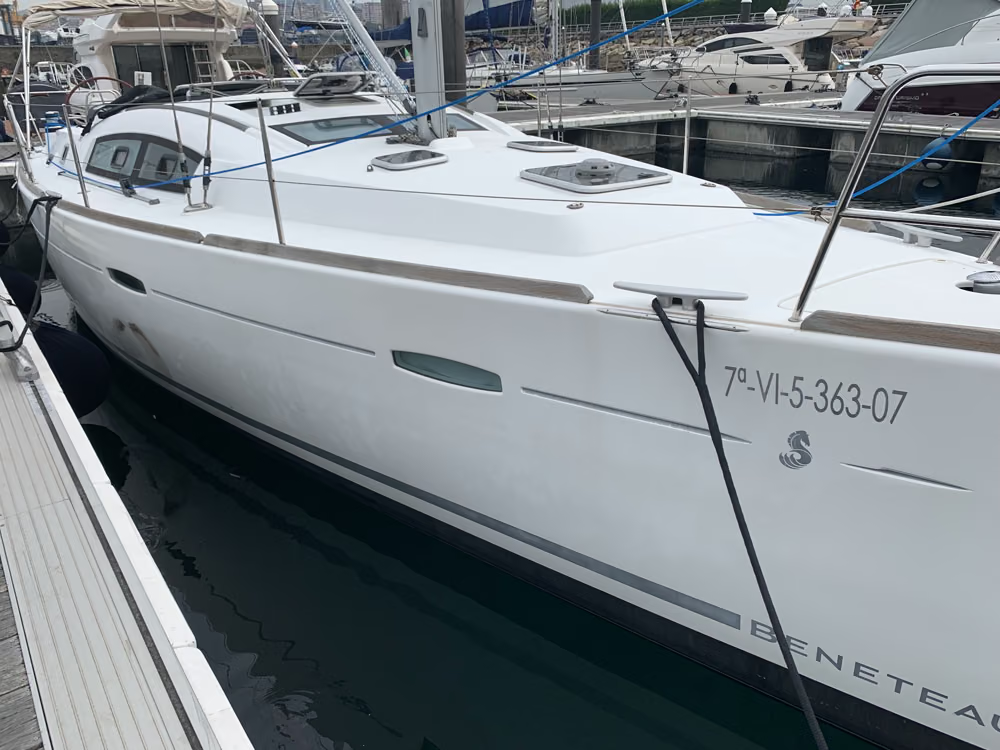
In one sentence: what is Lista Séptima?
Lista Séptima is one of the lists in the Ship Registry where recreational vessels whose exclusive use is sport without profit motive or non-professional fishing are recorded.
In other words: the weekend boat, the family sailboat, the dinghy for hobby fishing. Not the charter vessel, the sailing school, or any activity with financial consideration — that goes on Lista Sexta.
The legal definition is in Royal Decree 1027/1989, article 4.1.g):
«En la Lista Séptima, se registrarán las embarcaciones de construcción nacional o debidamente importadas, de cualquier tipo y cuyo uso exclusivo sea la práctica del deporte sin propósito lucrativo o la pesca no profesional.»
The Ship Registry and the «lists»: why do they exist?
In Spain, ships and vessels are not all registered in the same place. RD 1027/1989 divides the Ship Registry into nine lists, according to the vessel’s activity:
| Lista | Main use |
|---|---|
| 1ª | Offshore platforms, ocean-going tugs, support vessels |
| 2ª | Maritime transport of passengers and/or cargo |
| 3ª | Commercial fishing |
| 4ª | Fishing and aquaculture auxiliaries |
| 5ª | Port, roadstead and bay services |
| 6ª | Recreational vessels for profit (charter, schools…) |
| 7ª | Private-use recreational vessels |
| 8ª | Public-body vessels |
| 9ª | Vessels under construction |
For recreational boating, the big fork in the road is 6ª vs 7ª: commercial or private. That distinction is not cosmetic; it shapes inspections, insurance, taxation, and what you can legally do with your vessel.
Lista Séptima vs Lista Sexta
| Lista 7ª (private) | Lista 6ª (commercial) | |
|---|---|---|
| Use | Sport, leisure, non-professional fishing | Charter, professional rental, profit-making activities |
| Who sails | Owner, family, friends and cost sharing | Clients, students, renters |
| Inspections | List 7 regime | Stricter regime (commercial equivalent) |
| Registration tax | Yes (except exemptions) | Exempt since 2013 for new vessels |
| Change of list | Possible to 6ª (permanent) or temporary commercial use (see below) | Possible to 7ª if you leave commercial activity |
Most recreational vessels in Spain are on Lista 7ª. If you buy a boat from a private owner, it is almost certainly on this list.
Which vessels fall under Lista Séptima?
Under RD 1435/2010, article 2, a recreational vessel is one whose hull measures between 2.5 and 24 metres in length and is used for sport or leisure.
Outside this regime (with their own rules or no registration obligation):
- Vessels under 2.5 m (exempt from registration).
- Floating or beach craft (kayaks, boards, personal watercraft as craft…).
- Historic vessels, race-only vessels, or those with a temporary navigation permit.
- Lista 6ª vessels with more than 12 passengers.
How a boat is registered on Lista 7ª: two paths
RD 1435/2010 — today’s reference rule — distinguishes two regimes depending on length and CE marking:
1. General regime (flagging and registration)
Applies to vessels without CE marking, over 12 metres, or high-speed craft. The owner applies for flagging at the Maritime Captaincy of the chosen port of registry and receives the Spanish Registry Certificate – Navigation Permit.
Documentation, deadlines and forms: MITMA electronic office and Ministry information page.
2. Simplified regime (the «12-metre rule»)
If your vessel has CE marking, is 12 m or less, and is not high-speed, article 8 of RD 1435/2010 establishes a special regime:
- It is exempt from flagging, registration and dispatch.
- It must obtain a registration certificate before entering service.
- The administration has a maximum of 15 days to issue it.
- It must display the registration mark visibly on both bows.
- It may only sail in Spanish territorial waters, respecting the CE design category (A, B, C or D).
This regime made life much easier for owners of small dinghies and sailboats built in series under European rules. The preamble to RD 1435/2010 itself acknowledges that the earlier attempt — RD 544/2007 — had fallen short and needed improvement.
Obligations of a Lista 7ª boat owner
Regardless of the registration regime, sailing means complying with safety rules. The key pieces:
Periodic inspections. RD 1434/1999 governs surveys and inspections, carried out by authorised collaborating bodies or the administration itself.
Safety equipment. RD 339/2021 sets mandatory equipment according to navigation zone and length.
Third-party liability insurance is mandatory for recreational vessels.
Skipper qualifications must match the vessel and navigation zone.
Documentation on board: registration certificate or navigation permit, as applicable, plus valid inspection documentation.
A bit of history: how we got here
    timeline
    title Regulatory evolution of Lista 7ª
    1989 : RD 1027/1989 creates the Ship Registry lists
    2007 : RD 544/2007 simplifies flagging on Lista 7ª
    2010 : RD 1435/2010 unifies lists 6ª and 7ª and introduces CE ≤12 m regime
    2011 : RD 1435/2010 enters into force (repeals 544/2007)
    2023 : RD 186/2023 (RONM) modernises vessel dispatch
    2025 : DGMM resolution sets out temporary private → commercial change
1989 — The lists are born. RD 1027/1989 organises the Ship Registry into lists and defines Lista Séptima as the registry for non-profit sport-use vessels.
2007 — First simplification attempt. RD 544/2007 was the first specific regulation of flagging on Lista 7ª, in a context of growth in recreational boating and harmonisation with EU rules (recreational craft directives).
2010 — The rule in force today. RD 1435/2010, in force since 1 January 2011, repealed 544/2007 and brought two major changes: unified procedures for lists 6ª and 7ª, and a simplified regime for CE vessels up to 12 metres. The preamble explicitly aims for «simplicity, effectiveness and real service to citizens» without giving up legal certainty.
2021 — Equipment. RD 339/2021 updated safety equipment and pollution prevention.
The latest development: chartering without changing list (temporary change of use)
For decades, a Lista 7ª boat could not be used commercially. That changed with Royal Decree 186/2023 (Regulation on the Organisation of Maritime Navigation, RONM), whose article 9 allows a temporary change of use from private to commercial:
- The vessel stays on Lista 7ª; there is no formal change of list.
- Commercial use is limited to nautical chartering.
- Maximum 3 consecutive months per calendar year.
- Requires management by a nautical charter company (naval management contract).
- Inspections equivalent to Lista 6ª, extended insurance and express dispatch.
- During the commercial period, the boat carries the letters «CT» (Cambio Temporal) before the registration mark.
- Personal watercraft are excluded.
In July 2025, the DGMM published the Resolution of 17 July 2025 (BOE-A-2025-15205), which set out the technical conditions for this temporary change until the definitive regulation envisaged in a royal decree under preparation enters into force. The authorisation for change of use on the registry sheet is valid for up to 5 years (linked to the naval management contract).
If you are interested in earning income from your boat under this regime, we have a step-by-step guide to chartering your Lista Séptima vessel.
Frequently asked questions
Are Lista 7ª and Lista Séptima the same thing? Yes. It is the same list; «7ª» and «séptima» are equivalent ways of referring to it.
Can I move my boat from Lista 7ª to Lista 6ª permanently? Yes. RD 1435/2010 governs changes of list between 6ª and 7ª. It involves procedures at the Captaincy, meeting Lista 6ª requirements and, in practice, adapting inspections and insurance to the commercial regime.
Is a boat with a registration certificate (≤12 m CE) on Lista 7ª? Yes, even if it does not have a traditional registration number. When applying for registration, the holder chooses the list (6ª or 7ª) according to the intended use.
Can I charter my Lista 7ª boat without procedures? No. Private use does not authorise rentals. It is only possible through the temporary change of use regulated in the RONM or by moving permanently to Lista 6ª.
Official sources
These are the main regulatory and administrative references:
- RD 1027/1989 — Flagging, registration and maritime registry (definition of the lists).
- RD 1435/2010 — Flagging and registration on lists 6ª and 7ª (central rule in force).
- RD 544/2007 — Repealed predecessor (historical context).
- RD 1434/1999 — Inspections of recreational vessels.
- RD 339/2021 — Safety equipment and pollution prevention.
- RD 186/2023 (RONM) — Regulation on the Organisation of Maritime Navigation (dispatch and temporary change of use, art. 9).
- DGMM Resolution 17/07/2025 — Conditions for temporary private → commercial change.
- MITMA — Flagging and registration — Ministry administrative guide.
- MITMA electronic office — Registration and flagging — Online procedures.
Lista Séptima is not just another formality: it is the category that defines what your boat is for in the eyes of the administration. Understanding it helps you know what documentation you need, what you can do legally, and what options you have if one day you want to share your vessel with other sailors.